
1 · Get appointed
Letters of authority from the probate court.
and counsel
Your documents say 'divide equally.' Celestial Divide shows clients what that actually looks like — while they're alive to weigh in. A pre-mortem simulation that strengthens the plan, deepens the relationship, and heads off the family fight.
Free to start, no credit card · Click through the product below
The plan can be perfect on paper and still leave the hardest question — who gets what — to a grieving family with no mechanism to answer it.
Show clients the division before it's ever needed — while intentions can still be written into the plan.
A concrete reason for the yearly touchpoint: re-run the division as assets, values, and family circumstances change.
The structure you set today becomes the process your client's family follows when the time comes.
Most firms hand over documents. Yours hands over a working process — modern tooling clients notice and talk about.
The best time to divide an estate fairly
is before anyone has to.
Four steps that turn a tense, messy situation into a clear, documented plan — without pretending there's one perfect answer.
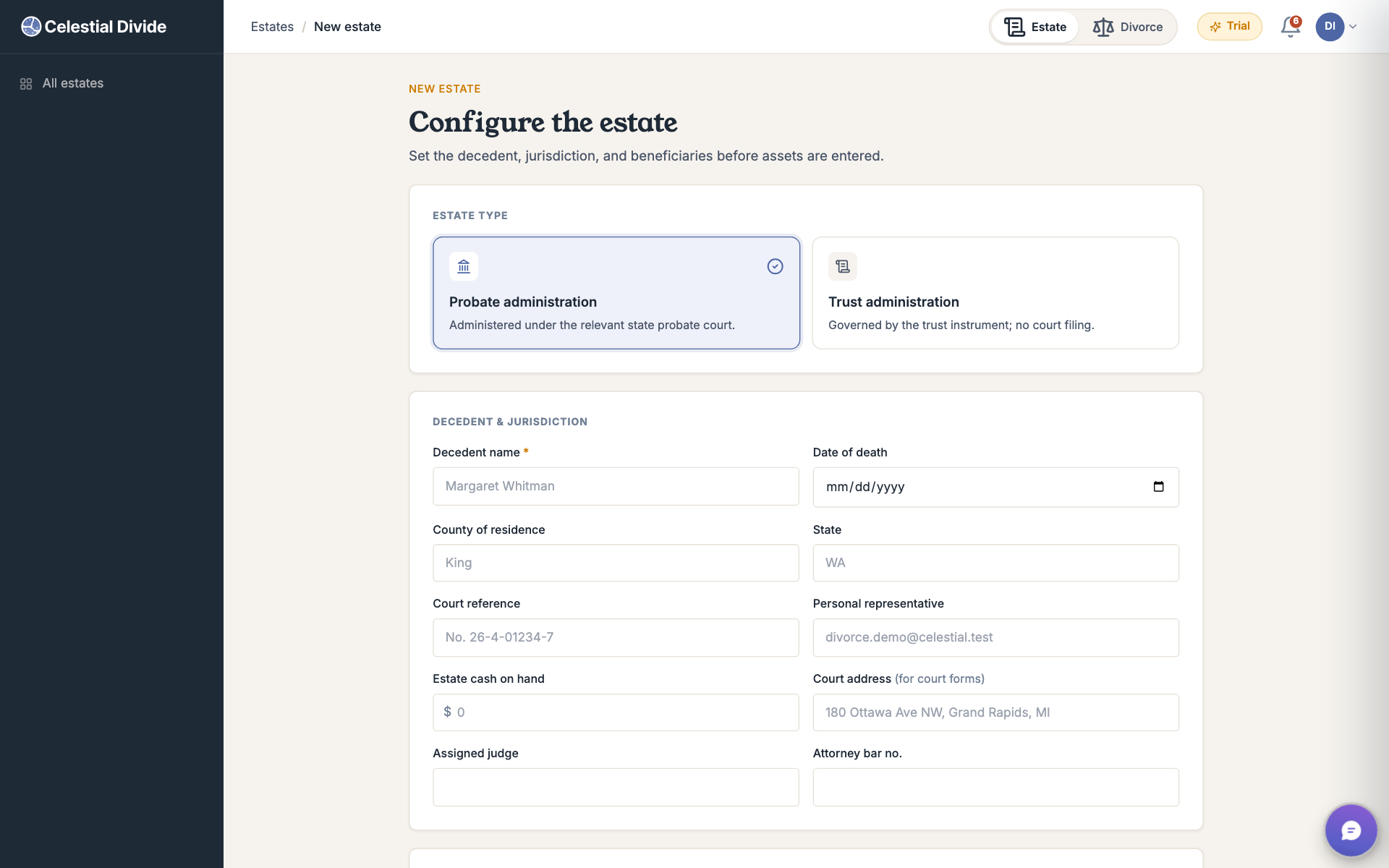
Create the estate, invite participants, and define what information is shared with whom.
Each person privately ranks and values what they care about — no awkward family meetings required.
The solver runs allocation scenarios and shows the tradeoffs side-by-side, in plain language.
Share results and a clear record of what was considered and why — ready for every stakeholder.
At the core of Celestial Divide is an optimization engine built on envy-free division — the branch of mathematics devoted to splitting things people care about. It weighs what each person values, then finds allocations where no one would trade their share for someone else's.
The same lake house is worth different things to different people. The engine works from each person's own valuations — not just the appraisals.
A pre-tax 401(k), a Roth, and a lake house are not the same kind of dollar. The engine runs tax-aware equalization and debt offsets, so scenarios compare what people actually receive.
Every recommendation comes with the reasoning behind it, in plain language — so "why did she get the house?" has a written answer.
The math of a fair division — preferences, valuations, equalization — outgrows a spreadsheet the moment two people want the same thing.
Estate settlement runs from the courthouse to the final tax return. Celestial Divide carries everything in between — inventory, valuations, division, and administration — and produces a clean, documented file for the legal steps at either end.
Letters of authority from the probate court.
Every asset in one place — property, businesses, brokerage accounts, IRAs, personal items.
Each beneficiary values every asset privately — no anchoring, no family meeting.
The fairness engine turns valuations into a defensible division blueprint.
Sales, payouts, cash on hand, and notices that keep every beneficiary informed.
Final filings and taxes.
Role-based access and clear boundaries keep information controlled and conversations constructive — even when emotions run high.
Control what each participant can see and do at every stage.
Conversations stay tied to decisions instead of spiraling into side channels.
Capture the "why" in plain language, alongside the outcomes.
Executors, professionals, and beneficiaries each get a purpose-built experience.
Estate plans start at $19 per month. Organization plans use one combined allowance for open estates and divorce matters.
Save 17% on annual
Build the estate record and keep it for as long as you need.
No card required · no time limit
Run the allocation and carry the accepted plan through administration.
Billed annually · save 17%
Billed monthly · cancel anytime
Add deeper fairness analysis and Michigan probate forms.
Billed annually · save 17%
Billed monthly · cancel anytime
No. Celestial Divide is a structured communication, scenario evaluation, and documentation tool. It does not replace professional guidance.
It can be helpful once it's clear assets need to be divided and multiple people's preferences must be considered.
That's expected. The platform makes preferences and tradeoffs visible so disagreements can be addressed constructively.
No. It reduces friction and helps everyone stay aligned, while professionals provide the appropriate guidance for the situation.
Only what's necessary. Access is controlled by role, and you choose what gets shared at each stage.
Yes - you can share outcomes and documentation in a way that keeps everyone aligned on what was decided and why.
The goal isn't to eliminate disagreement — it's to replace confusion with a clear process, so decisions are understood, documented, and easier to carry forward.
Free to start, no credit card.